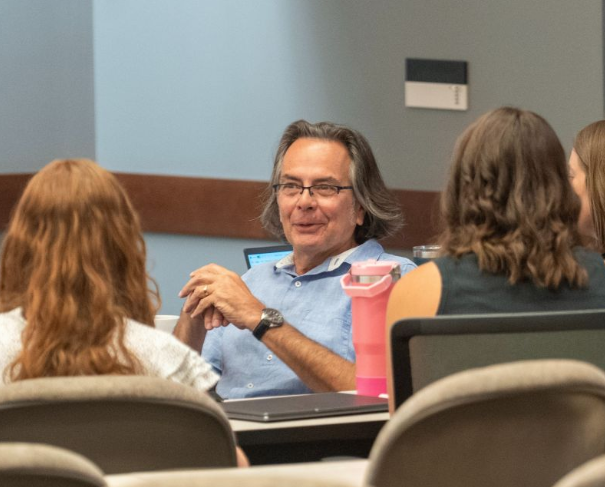
Dr. Michael “Mike” Oglesbee, DVM, PhD, DACVP, will be retiring on June 30, 2026, after a distinguished, decades-long career at The Ohio State University marked by scientific innovation, visionary leadership, and transformative impact on interdisciplinary infectious disease research. As director of the Infectious Diseases Institute (IDI), professor of virology and veterinary neuropathology, Fellow of the American Association for the Advancement of Science, and Distinguished Member of the American College of Veterinary Pathologists, Dr. Oglesbee will leave behind a legacy that has profoundly shaped Ohio State’s interdisciplinary research ecosystem and advanced global understanding of viral pathogenesis.
A Scholar Rooted at Ohio State
Dr. Oglesbee’s academic journey is deeply intertwined with Ohio State. He earned both his DVM (summa cum laude) and PhD from The Ohio State University, later becoming a Diplomate of the American College of Veterinary Pathologists and being named a Fellow of the American Association for the Advancement of Science for his contributions to understanding virus–heat shock protein interactions. He joined the university’s faculty in 1989, ultimately serving as a professor in the Department of Veterinary Biosciences within the College of Veterinary Medicine, where he also served as department chair for seven years. Over nearly four decades at Ohio State, his research, teaching, and mentorship shaped generations of scientists, veterinarians, and interdisciplinary scholars.
Pioneering Research in Viral Neurovirulence and Heat Shock Biology
A hallmark of Dr. Oglesbee’s research program is its pioneering work uncovering how heat shock proteins (HSPs)—particularly hsp70—mediate both viral replication and host immune responses during infection of the nervous system. His laboratory was among the first to explore how cellular stress responses influence viral spread and disease severity in the nervous system. These findings have shaped foundational understanding of viral neurovirulence and innate immune activation.
Key contributions include:
- Virus–HSP interactions: His group demonstrated that hsp70 is induced by diverse viruses—including measles, canine distemper, and vesicular stomatitis virus—and supports intracellular viral replication, revealing a conserved virus–host interaction across multiple viral families.
- Paradoxical protective effects: In mouse models, hsp70’s early release from viable neurons enhanced T‑cell–mediated immune clearance through interferon‑β pathways, uncovering a surprising protective role for hsp70 in limiting viral neurovirulence despite its support of viral replication.
- Exosome‑mediated innate immunity: His laboratory showed that the protective effects of hsp70 reflect exosomal release of hsp70 from virus infected neurons, triggering robust innate immune activation in uninfected brain macrophages. This mechanism, which operates independently of viral interference, has broad implications for virology, immunology, and neuroinflammation.
These findings support a host protective role for the phylogenetically conserved febrile response. Fever is a potent inducer of hsp70, and higher levels of intracellular hsp70 cell result in higher level of release from virus infected neurons, resulting in more robust induction of host protective innate immune responses. Findings challenge therapeutic approaches focused on suppressing the febrile response in the face of virus infection of the nervous system, except in instances where the host is immune compromised or where excessive febrile temperatures induce coagulopathies. Work in Dr. Oglesbee’s laboratory substantiated both of these latter risk factors. Importantly, these findings have broad virological relevance.
Dr. Oglesbee’s groundbreaking contributions to understanding virus–heat shock protein interactions earned him election as a Fellow of the American Association for the Advancement of Science (AAAS), recognizing the global impact of his work on infection, virulence, and antiviral immunity. His scientific achievements have also been central to the scholarly distinction honored in his selection as a 2025 Distinguished Member of the American College of Veterinary Pathologists (ACVP), reflecting more than 45 years of influential research, mentorship, and service to the profession.
A Prolific Scientific Contributor
Dr. Oglesbee’s publication record spans diverse areas of virology, neuropathology, and immunology, reflected in more than 4,000 citations and an h-index of 43. His work includes foundational studies on paramyxoviruses, measles virus protein interactions, and viral evolution.
Highlighted contributions include:
- Structural and functional analysis of measles nucleoproteins and their regulatory domains
- Studies on neuroinflammatory mechanisms in viral encephalitis
- The role of extracellular hsp70 as an inflammatory mediator in non-infectious disorders of the nervous system
His sustained scientific influence is evident across veterinary science, medical microbiology, immunology, and beyond.
Transformative Leadership of the Infectious Diseases Institute
As Director of the Infectious Diseases Institute, Dr. Oglesbee strengthened Ohio State’s position as a national leader in infectious disease scholarship. Under his leadership, IDI:
- Transitioned to a formal university institute in 2017, evolving from its roots in the Public Health Preparedness in Infectious Diseases Program (PHPID) and as one of the university’s Discovery Theme Initiatives
- Grew IDI membership to over 1,000 members representing 13 colleges and external partners working across human, animal, plant, and environmental health
- Expanded interdisciplinary research programs, thematic areas, and collaborative networks, and established the IDI Genomics and Microbiology Solutions Lab (IDI‑GEMS), which includes Buckeye Tick Test, the only academic- based tick-borne pathogen testing facility of its kind in the state
- Expanded funding, mentorship opportunities, training programs, and scientific visibility across the university and the state, while elevating IDI’s profile nationally and internationally
- Established the IDI as a United Nations Food and Agriculture Organization (UN FAO) Reference Center for both antimicrobial resistance and zoonotic coronaviruses, and inaugural UN FAO member of the World Health Organization Global Coronavirus Surveillance Network
- Led IDI’s role in mobilizing interdisciplinary research to prevent pathogen emergence, a defining theme of his tenure, and strengthened IDI’s partnership with the College of Food, Agricultural, and Environmental Sciences to support and position the Plant and Animal Agrosecurity Research (PAAR) Facility — one of only two facilities in the nation with capacity for both plant and large animal research at BSL‑3 and BSL‑3 Ag safety levels — for long‑term sustainability
- Formalized IDI’s Senior Staff Leadership Team, a pivotal organizational framework to advance interdisciplinary research strategies, programming, partnerships, and operational cohesion
His leadership philosophy centered on building interdisciplinary networks rather than silos—driving innovation by connecting microbiologists, clinicians, veterinarians, epidemiologists, engineers, and data scientists.
A Champion for Student Training and Mentorship
Beyond his formal roles, Dr. Oglesbee made major contributions to training future scientists:
- Faculty Director of the College of Veterinary Medicine’s Signature Program in Infectious Disease
- The signature program is tightly aligned with university-wide infectious disease initiatives through the IDI, positioning college strengths to emphasize a One Health approach.
- Director of the College of Veterinary Medicine Summer Research Program, including his role as Principal Investigator of a NIH T35 training grant which supports veterinary student research experiences
- The T35 is funded through 2029, representing twenty years of support from the NIH for a total of two hundred student experiences. This is in addition to securing competitive funding from Boehringer Ingelheim which supports an average of five students per year.
- Director of the combined Veterinary Pathology Training/PhD Graduate Program, a division of the Comparative Biomedical Sciences Graduate Program in the College of Veterinary Medicine
- The program is one of the only programs in the nation that supports concurrent medical specialty training and research, and has a strong track record of veterinary pathology board certified PhD graduates who go on to become leaders in industry and academia.
- Developed an IDI-funded postdoctoral trainee position as part of the Interdisciplinary Program in Microbe-Host Biology
- The Interdisciplinary Program in Microbe-Host Biology, a graduate and postdoctoral training initiative through a partnership between the IDI and the College of Medicine, is an NIH T32-funded program supporting interdisciplinary training and mentorship for graduate students and postdoctoral fellows. The IDI funds one additional pre-doctoral position, and the College of Medicine supports a pre/post-doctoral position. Three graduate programs are represented (College of Medicine, College of Medicine, and Microbiology in the College of Arts and Sciences). The program is led by Drs. Rajendar Deora and Daniel Wozniak, College of Medicine.
His mentorship fostered the next generation of infectious disease researchers, many of whom now lead their own labs, clinical programs, or public health initiatives.
Honors and Recognition
One of the most distinguished honors of Dr. Michael Oglesbee’s career is his election as a Fellow of the American Association for the Advancement of Science, a recognition awarded to individuals who have made scientifically or socially distinguished contributions to their field. This honor reflects the depth and impact of his pioneering research at the intersection of virology, neuropathology, and cellular stress biology. This recognition places Dr. Oglesbee among a select international community of researchers whose work has meaningfully shifted scientific paradigms. It also underscores the far‑reaching influence of his research program at Ohio State, which has bridged veterinary medicine, human infectious disease, immunology, and neurobiology.
Dr. Oglesbee was recently named a 2025 ACVP Distinguished Member. This honor reflects his influential scholarship, exemplary mentorship, and significant contributions to the American College of Veterinary Pathologists and the advancement of veterinary pathology.
Legacy and Impact
Dr. Oglesbee’s career is defined by scientific rigor, collaborative spirit, interdisciplinary research, programming, and partnership, along with a deep commitment to the One Health approach. Through his leadership of IDI, foundational research in viral neuropathogenesis, and decades of teaching and mentorship, he has:
- Strengthened the IDI and Ohio State’s role as an interdisciplinary powerhouse
- Advanced global understanding of virus-host interactions
- Expanded training pipelines for the nation’s future research workforce in infectious disease, comparative pathology, and veterinary clinician scientists
- Positioned the university at the forefront of emerging pathogen preparedness
His upcoming retirement will mark the conclusion of a remarkable chapter, but his legacy will continue in the students he trained, the interdisciplinary networks and partnerships he built, the leadership he provided, and the scientific fields he helped shape.